

On June 9, the Medicare Trustees published their annual report on the financial outlook for the Medicare program. The report calls attention to the serious fiscal challenges facing the Medicare program, which provides coverage to about 70 million Americans aged 65 and older and people with disabilities. It also highlights the large and increasing burden that high Medicare costs place on Medicare beneficiaries and taxpayers. This blog discusses key takeaways from the 2026 Medicare Trustees report, including the rapid growth in Medicare spending in parts B and D and the important role Medicare Advantage plays in driving spending.
Medicare’s Hospital Insurance (HI) Trust Fund Projected to Reach Insolvency in 2033
The Trustees report’s headline news is that the Hospital Insurance (HI) trust fund is expected to reach insolvency in 2033, three months earlier but in the same year as previously projected. The HI trust fund pays for Part A services, such as inpatient hospital stays, skilled nursing and other post-acute care services, as well as hospice care for Medicare beneficiaries. At the point of insolvency, the HI trust fund will be able to reimburse providers only 89 cents for every dollar of Part A services provided, and substantial spending reductions or tax increases will be needed to close the shortfall.
The slight deterioration in the status of the HI trust fund relative to last year’s projection is largely due to changes in the taxation of Social Security benefits enacted in the One Big Beautiful Bill Act that will reduce the trust fund’s revenue.
Focus on the HI Trust Fund Obscures the Bigger Picture of Medicare’s Worsening Fiscal Situation
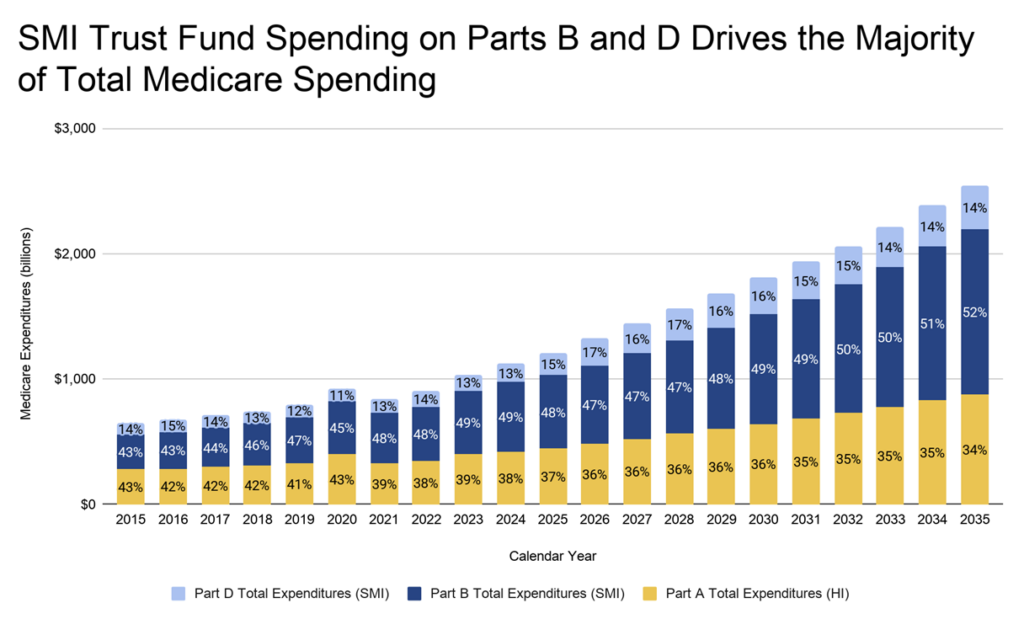
While the HI insolvency year receives significant attention and is pointed to as an indicator of the fiscal health of the Medicare program, perhaps an even more important part of the story relates to spending in the rest of the Medicare program. Spending on outpatient services (Part B) and prescription drugs (Part D) is a larger and faster-growing share of total Medicare spending. The cost of Part B alone – $584 billion in 2025 – dwarfs spending in Part A ($444 billion), and the share of Medicare spending attributed to Part A is declining over time as spending shifts from inpatient to outpatient services.
Source: 2026 Medicare Trustees’ Report Tables III.B4, III.C4, and III.D3
Medicare spending reached more than $1.2 trillion in 2025, and the Medicare Trustees project it will cost nearly $19 trillion over the next decade. This growth is driven by two main factors: 1) the continued aging of the baby boomers into Medicare, and 2) an increase in the volume and intensity of services that Medicare enrollees are receiving. Due to its rapid growth, Medicare spending is projected to continue outpacing the growth in the overall economy, increasing from 3.9% of gross domestic product (GDP) in 2025 to 6.5% by 2050.
Relative to last year’s report, Medicare Part D spending increased substantially in large part due to increased utilization of GLP-1s and high-cost specialty drugs. Projected Part B spending decreased in the short term with recent changes to payments for skin substitutes, but will grow more quickly over the longer term as spending for Part B drugs, typically physician administered drugs, increases.
Spending Growth in Medicare Parts B and D Increases the Financial Burden on Beneficiaries and Taxpayers
The high cost of Medicare Parts B and D places an increasing burden on beneficiaries and taxpayers over time, as higher beneficiary premiums and a larger share of general revenues are required to finance this spending. This is because the trust fund that pays for Part B and Part D services is financed differently from the HI trust fund in important ways.
The HI trust fund pays for services covered by Medicare Part A and is primarily financed through dedicated Medicare payroll taxes on earnings. Beginning in 2027, spending on Part A services will exceed the HI trust fund’s income and begin to draw down the trust fund’s reserves. When the HI trust fund becomes insolvent in 2033, its reserves will be depleted and new revenue coming into the trust fund will be insufficient to cover the full anticipated Medicare cost of Part A services. To date, Congress has always stepped in to avert the insolvency of the HI trust fund.
The Supplementary Medical Insurance (SMI) trust fund pays for all of Part B – outpatient care including physician services, as well as durable medical equipment – and Part D-covered outpatient prescription drugs. In contrast to the HI trust fund, the SMI trust fund can never become insolvent. It is financed through a combination of Medicare beneficiary premiums and federal general revenue (largely corporate and personal income taxes), adjusted each year to cover the anticipated costs of Parts B and D. As the cost of providing the services covered by Parts B and D grows, so do the premiums beneficiaries pay and the amount of general tax revenues needed to fund the Medicare program.
The rapid rise in spending in Parts B and D translates into higher premiums and cost sharing for Medicare beneficiaries. Beneficiary premiums finance about one-quarter of spending in Parts B and D. In 2026, the standard monthly Part B premium jumped by almost 10% to $202.90, exceeding $200 a month for the first time. Annual Part B premiums will increase by 6.6% on average over the next 10 years. The Trustees expect Part D premiums to grow at an even faster pace during that period due in part to the expiration of additional subsidies to dampen premium increases after Part D’s benefit redesign.
As the cost of Part B and D benefits increases over time, a greater share of beneficiaries’ Social Security benefits will likely go to paying these higher out-of-pocket costs. The combined average premiums and cost-sharing that beneficiaries pay for Parts B and D are about one-quarter of the average Social Security benefit in 2026. By 2050, premiums and cost-sharing will increase to more than one-third of the average benefit.
The high cost of Parts B and D also increases the burden on taxpayers who finance the remaining three-quarters of the spending through general revenues, which are primarily deficit-financed. Medicare spending is a major source of growing federal deficits and the increase in the federal debt, which can limit the government’s ability to invest in other priorities and crowd out private investment. Over the next decade, Medicare spending is projected to account for the largest increase in federal spending as a share of GDP, other than outlays for interest on the federal debt. Spending on all other mandatory health programs is projected to decline.
The Increased Role of Medicare Advantage in Driving Medicare Spending
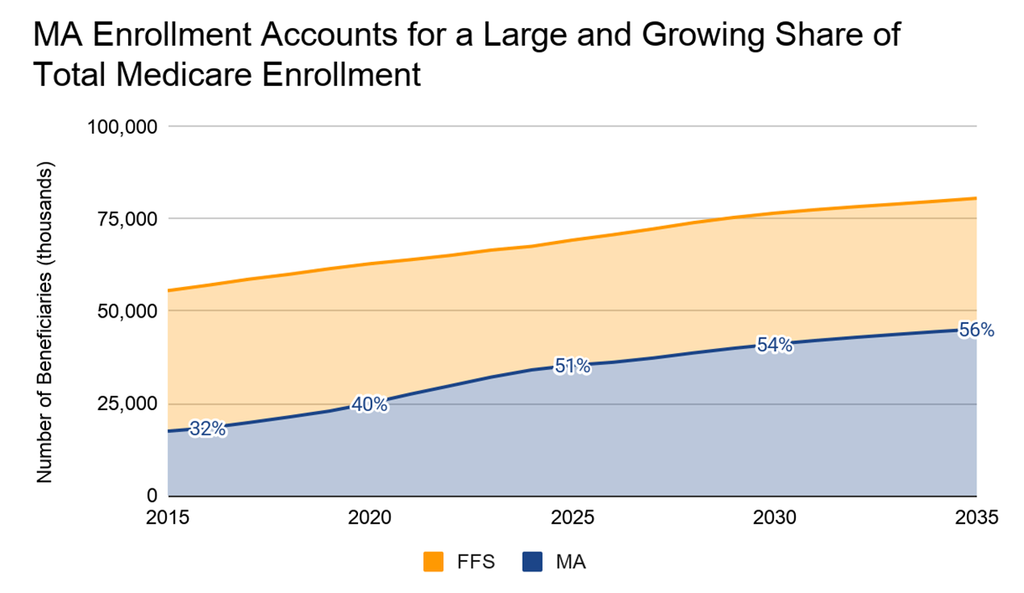
MA accounts for the majority of Medicare enrollment today. MA enrollment experienced a substantial increase over the past decade – rising from 34% of total enrollment in 2017 to 51% today – and is projected to increase to 56% by 2035.
Source: 2026 Medicare Trustees’ Report, Table V.B3
Payments to MA plans are an increasingly important driver of overall Medicare spending as enrollment in MA grows. Over the next decade, MA alone will account for more than $9 trillion of Medicare’s total spending. However, MA is not funded from its own trust fund, and payments to MA will draw on both the HI and SMI trust funds to cover the cost of the Part A and B services these plans provide to enrollees. Roughly 40% of MA plans’ funding comes from the HI trust fund, and 60% comes from the SMI trust fund, although these shares change over time.
A substantial body of evidence finds that the Medicare program pays more to cover MA enrollees than it does for similar beneficiaries enrolled in traditional Medicare. In 2026, Medicare will spend about 14% more to cover MA enrollees, translating into $76 billion in additional spending this year alone.
Coding intensity and favorable selection into MA are responsible for much of this higher spending, although factors such as the quality bonus program in MA and the way MA payment benchmarks are set also play a role. The higher payments to MA plans contribute to rising Part B premiums for beneficiaries in both traditional Medicare and MA, resulting in beneficiaries paying about $11 billion more in premiums in 2026.
Conclusion
The Medicare Trustees report paints a bleak picture of Medicare’s financial health and highlights the urgent need for reforms to lower Medicare spending. Medicare spending is projected to continue increasing faster than Medicare payroll taxes and faster than the overall economy, resulting in projected insolvency of the HI trust fund in the next seven years. Perhaps even more concerning are the projections of higher beneficiary premiums and the need for more deficit-financed general revenue to sustain the program.
Policymakers and experts have proposed a number of solutions that could improve the Medicare program’s fiscal outlook, including reducing wasteful spending in Medicare and raising additional revenue to finance the trust fund. This year’s report emphasizes the important role MA, certain outpatient services, and drugs play in driving Medicare spending. These are all places policymakers could look to when weighing reforms to reduce the program’s spending. A set of policy changes will likely be needed to fully close the Medicare HI trust fund shortfall and slow the growth of Parts B and D spending to put the program as a whole on sounder financial footing.
For a description and brief analyses of potential reforms to the MA and Part D programs, see MPI’s compendium of policy proposals.